Offering a friendly and accessible opportunity to study languages at all levels.
Background
Ancient Voices began life as the CAS Greek & Latin Summer School in 2019. Originally, this was a bricks-and-mortar languages school in the style found in different places across the UK and further afield. We enjoyed working with a a relatively small but dedicated cohort in Edinburgh, with students undertaking Ancient Greek and Latin at all levels. As part of this summer school, we also offered taster classes in Hebrew and Egyptian Hieroglyphs, as well as other non-language sessions. The popularity of these additional sessions was self-evident, and so we committed to offering other, less commonly available options in future iterations. As with so many other initiatives, the coronavirus pandemic meant that we were forced to cancel our 2020 summer school and move all our outreach efforts online.
Over 2020 and into 2021, CAS offered a range of free online taster sessions in different topics: from Latin epigraphy to Hellenistic coins, from Ancient Greek language to Scottish Neo-Classicism and ancient reception. These sessions opened up Scottish-based Classics outreach to a global audience, with the result that we decided to switch our newly-dubbed Ancient Voices programme to an online footing permanently.
Our 2021 online Ancient Voices programme added Hebrew and Hieroglyphs for beginners as formal options for the first time. Our cohort was four times larger than our 2019 summer school, and included learners from all over the world. Not satisfied to rest on our laurels, however, we determined to add yet more options to the line-up. Our 2022 summer school added Aramaic and Sumerian options. This was our first summer school to reach over 100 participants. In 2023, we pushed the envelope further, adding Ugaritic to the mix, as well as offering a non-language course on the legacy of the Classical world. During 2023, we also piloted a range of language and non-language evening classes throughout the year, offering learners at different stages the chance to engage with us year-round. In the last couple years, we have sought to diversify our summer programme even more, with classes in Hurrian and Ethiopic, and a unit dedicated to the intersection between Classics and Theology. We are determined to share access to the ancient world, in all its multi-cultural and multi-linguistic vibrancy, with as many learners as we can!
Ethos
As a component in CAS’ wider outreach and public engagement strategy, the guiding ethos for Ancient Voices has always been accessibility. We are aware that Classics is a discipline which carries a legacy of historical inequity, one result of which is an ongoing disparity in access to the subject matter for learners across varied communities. We want the global Classics community to be so much more than simply those attached to prestigious research centres: whether you are a professional in the discipline, a student or an interested amateur, we believe there is room for you to enjoy Classics and make your own meaningful contributions to the subject.
Founded on these values, our Ancient Voices programmes are designed to be a low-stakes and nurturing environment, timed to fit in with pre-existing work, family and other commitments, without monopolising our students’ week. We recognise that not everyone has the luxury of time to commit to ceaseless study of the ancient world!
The majority of our courses are accessible to absolute beginners, and those with no background in the subject. We do offer more advanced level courses in our summer programme, however, and our evening classes sometimes require a small amount of preparatory reading.
Ancient Voices Organisers
Ancient Voices is fortunate to work with a range of skilled educators at different stages in their academic careers: from experienced schoolteachers to recently minted doctoral students, tutors in Continuing Education and faculty members at universities in Scotland and beyond. As this is a programme founded on equity of opportunity, we particularly enjoy supporting and working with classicists who face employment precarity, offering a chance to display their professional skills with the promise of a fair reimbursement for their time and expertise.
Overseeing the programme as a whole are the following individuals, who are more than happy to receive questions and enquiries about Ancient Voices:
Dr Sam Newington
Ancient Voices Academic Director
s.newington@abdn.ac.uk
Sam is a Senior Lecturer in the School of Divinity, History, Philosophy and Art History at the University of Aberdeen. She a co-founder of the Ancient Voices programme, and has personally taken a leading role in teaching Greek and Latin classes as part of the summer school. Aside from her work in Classics, Sam is a very keen distance runner
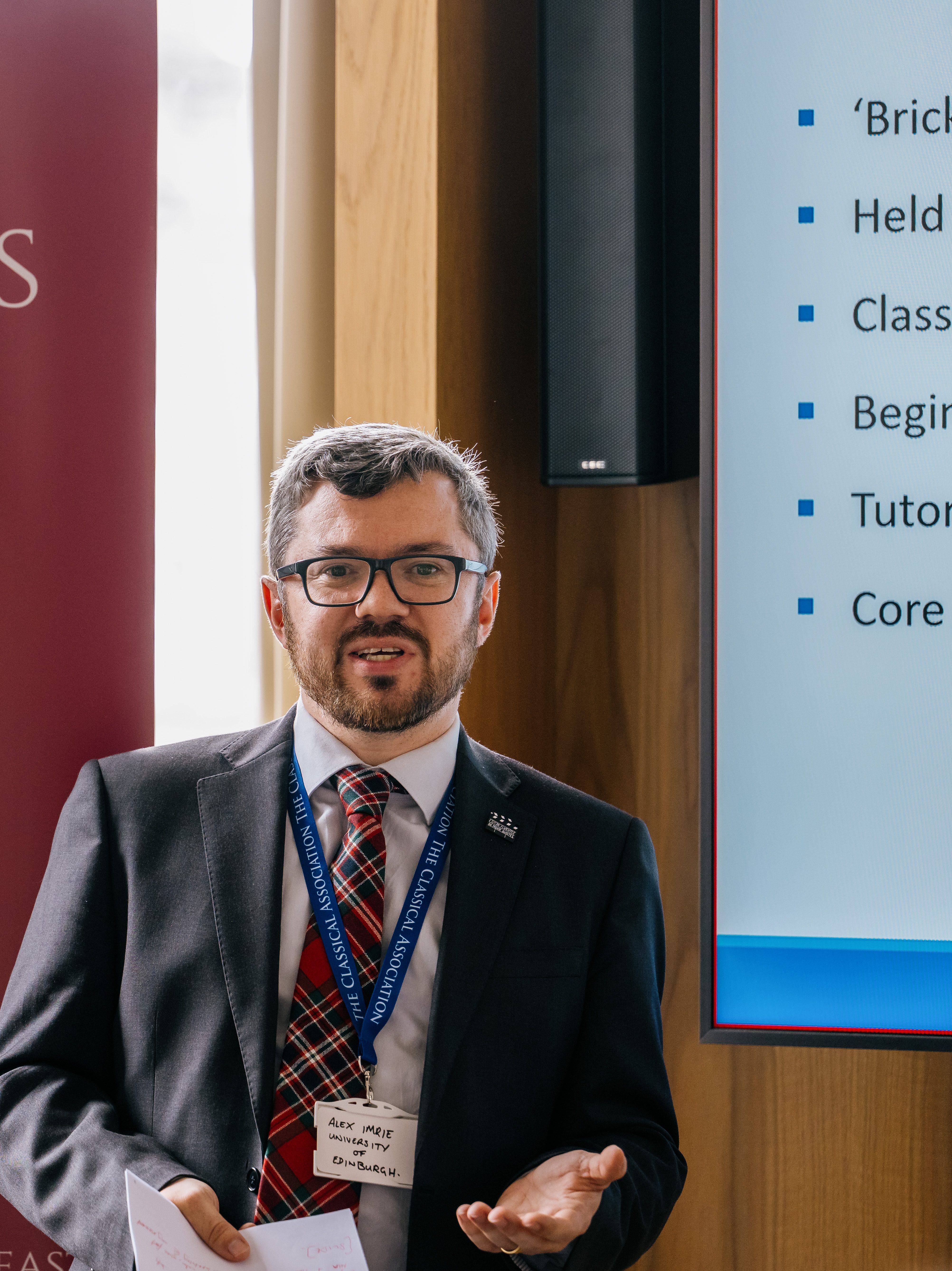
Dr Alex Imrie
Secretary of the Classical Association of Scotland
A.Imrie@ed.ac.uk
Alex is a Teaching Fellow in Ancient History at the University of Edinburgh. He is a co-founder of the Ancient Voices programme, working simultaneously as the Scottish Network Co-Ordinator for the educational charity Classics for All. Outside academia, Alex is a keen board-gamer, cyclist and amateur tartan designer.
2026 Ancient Voices Course Team
Sam Newington
Sam is a Senior Lecturer in the School of Divinity, History, Philosophy and Art History at the University of Aberdeen. She a co-founder of the Ancient Voices programme, and has personally taken a leading role in teaching Greek and Latin classes as part of the summer school. Aside from her work in Classics, Sam is a very keen distance runner
Terry Walsh
Terry Walsh MPhil (KCL) is a semi-retired teacher of Classics and Modern Languages, who has worked full-time at six different schools in England: he mainly taught Latin to pupils aged 8 – 18 and Classical Civilisation (age range 14 – 18); he has also, periodically, taught Classical Greek (ages 11 – 18) and Ancient History (at A Level); he was sometimes also called upon to teach French or Spanish and has also covered both AS and A Level Critical Thinking; at his final school, he both taught and led the teaching of the EPQ (Extended Project Qualification). Latterly, he has been involved in the JACT Greek and Latin Summer School in Durham (2016 – 24). He has led numerous study trips to Greece and Italy.
Martin Worthington
Martin Worthington is an Assyriologist at Trinity College Dublin. He is the author of two specialist books, and of Teach Yourself Complete Babylonian. He is currently, together with Mark Chetwood, working on an equivalent volume for Sumerian. In 2019, Martin directed the world’s first Babylonian-language film The Poor Man of Nippur (freely available on Youtube), acted by his students, and in 2021 he was consultant on Babylonian and Sumerian for the Marvel film “Eternals”.
Mark Chetwood
Having studied Classics at Cambridge in the 1970’s, Mark has recently returned to his love of ancient languages and literature following an international business career of almost 40 years. He studied Babylonian with Martin Worthington, and has been inspired by Martin to continue and deepen his studies. He shares a passion for making the learning of Sumerian available to a wide audience.
Nathaniel Greene
Nathaniel is a Lecturer in the School of Divinity at University of Aberdeen. He has previously taught at the University of Wisconsin-Madison and Brandeis University in the US. He is a longtime friend of Ancient Voices, and has offered Hebrew, Aramaic and Ugaritic courses to enthusiasts from around the world.
Benoit Saba
Benoit is a PGR student in Divinity (Religious Studies) at the University of Aberdeen. My research focuses on ancient mythologies and the theories of myth, primarily related to the Mediterranean world (Greek, Roman, or Egyptian).
Antonia Ruppel
Antonia Ruppel is a Classicist by training, but has been moving steadily east since her undergrad days, becoming first an Indo-Europeanist and then an Indologist. She has been teaching Latin, Greek and Sanskrit since 2005, first at universities in the US, UK and Germany and currently online for yogicstudies.com. Her Cambridge Introduction to Sanskrit was published in 2017, and she is currently preparing a book ‘Sanskrit for Classicists’ to be published by CUP.
Amelia Chia Holloway Lang
Amelia Lang is an independent scholar in the field of Classical Studies, who completed their doctorate at the University of Aberdeen. Her thesis, ‘Atoning Ashes and the Sacrificial Body: Mythology and Funerary Culture in Ancient Greece’, explored how religion and mythology affected burial and ritual attitudes towards death and mortality. Following her PhD, Amelia has been conducting research into ancient Greek monsters, paticularly the Sirens’ post-Homeric carrion-bird physicalities, along with cultural perceptions of gender and corruption of the normative motion and location of male bodies (publication forthcoming). She is now working on her first monograph, which is a study of monstrous appetites and non-normative consumption in ancient Greece and Rome.
Antony Makrinos
Antony is an Associate Professor in the Department of Greek and Latin at University College London. He was born and educated in Greece before completing his Master’s and PhD at UCL, focusing on Eustathius’ commentary on Homer’s Odyssey, continuing there as a post-doctoral research fellow. Since then, he has taught at Queen Mary University of London, and King’s College London. Since 2012, he has been a faculty member of UCL. He is also a member of EUROCLASSICA, and directed UCL’s own Summer School in Homer.
| Monday | Tuesday | Wednesday | Thursday | Friday | Saturday | Sunday | |
| 10am – Noon | Greek Beginners | Latin Beginners | Greek Intermediate | Latin Intermediate | Egyptian Hieroglyphs | ||
| 1pm – 2.30pm | Sumerian Cuneiform | Sanskrit for Classicists | Sumerian Cuneiform | ||||
| 3pm – 5pm | Ugaritic | Aramaic | Hurrian | Hebrew | |||
| 5.30pm – 7.30pm | Latin Advanced | Greek Advanced | Guest Lectures | Greek Myth & Tragedy |
 Classical Association of Scotland